The data below is presented in support of the CON Seed Grant Proposal entitled Pandemic, Protests, and Perseverance: Learning from the Experiences of BIPOC Nursing Students through Participatory Photography, by Jennifer Fricas, PhD, MPH, RN
The full proposal can be accessed here, and the budget for the proposal can be found here.
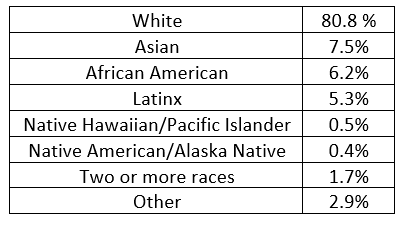
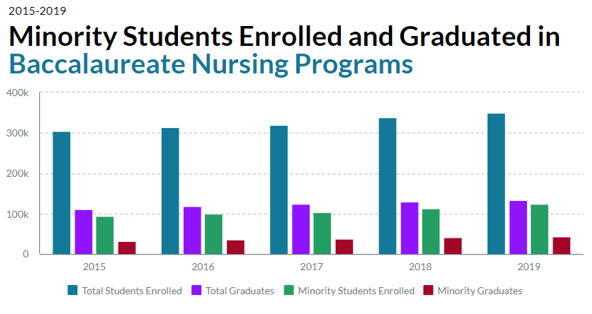
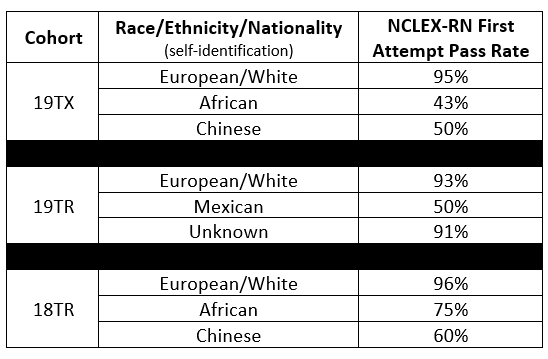
Tables and Graphics
References
- Seattle University Office of Diversity and Inclusion. (2020). LIFT SU: Inclusive excellence action plan for racial equity and antiracism 2020-2021. Retrieved from https://www.seattleu.edu/diversity/.
- Smedley B.D., Stith A.Y., & Nelson A.R. (Eds.) (2003). Unequal treatment: confronting racial and ethnic disparities in health care. Washington: National Academies Press.
- Agency for Healthcare Research and Quality. (2012). National healthcare disparities report, 2012. Retrieved from http://www.ahrq.gov/research/findings/nhqrdr/nhdr12/nhdr12_prov.pdf.
- CDC. (2013). CDC health disparities and inequalities report – U.S. 2013. Retrieved from https://www.cdc.gov/minorityhealth/CHDIReport.html
- Phillips, J. M., & Malone, B. (2014). Increasing racial/ethnic diversity in nursing to reduce health disparities and achieve health equity. Public Health Reports, 129(Suppl 2): 45–50.
- AACN. (2019). Enhancing diversity in the workforce. Retrieved from https://www.aacnnursing.org/Portals/42/News/Factsheets/Enhancing-Diversity-Factsheet.pdf
- AACN. (2020). Latest data on diversity. Retrieved from https://www.aacnnursing.org/Diversity-Inclusion/Latest-Data.
- EAB. (2016). 90% of low income first-gen students don’t graduate on-time. But colleges can change that. Retrieved from https://www.eab.com/daily-briefing/2016/03/16/90-percent-of-low-income-first-gen-students-dont-graduate-on-time-but-colleges-can-change-that
- Engle, J. & Tinto, V. (2008). Moving beyond access: College success for low-income, first-generation students. Retrieved from http://files.eric.ed.gov/fulltext/ED504448.pdf.
- Phillips, J. M., & Malone, B. (2014). Increasing racial/ethnic diversity in nursing to reduce health disparities and achieve health equity. Public Health Reports, 129(Suppl 2): 45–50.
- Aurelien, L. (2011). The nursing profession diversity challenge: Individual and institutional factors that influence the academic and NCLEX-RN success of racial/ethnic minority students in an Associate Degree program [Unpublished doctoral dissertation]. University of Florida.
- Bassett, M.T., Chen, J.T., & Krieger, N. (2020). Variation in racial/ethnic disparities in COVID-19 mortality by age in the United States: A cross-sectional study. Retrieved from https://journals.plos.org/plosmedicine/article?id=10.1371/journal.pmed.1003402
- Kim, H.N., Lan, K.F., & Nkyekyer, E. (2020). Assessment of disparities in COVID-19 testing and infection across language groups in Seattle, Washington. Retrieved from https://jamanetwork.com/journals/jamanetworkopen/fullarticle/2770951.
- Abou-Sabe, K., McFadden, C., & Martinez, D. (2020). ‘Hit us at our core’: Vulnerable Navajo Nation fears a second COVID-19 wave. Retrieved from https://crh.arizona.edu/news/2815
- Thomas, K. (2020). COVID exacts high toll among Filipino nurses. Retrieved from https://www.medpagetoday.com/nursing/nursing/88812.
- Harderman, R.R., Medina, E.M., & Boyd, R.W. (2020). Stolen breaths. Retrieved from https://www.nejm.org/doi/full/10.1056/NEJMp2021072?query=featured_home
- Wang, C. & Burris, MA. (1997). Photovoice: Concept, methodology, and use for participatory needs assessment. Health Education and Behavior, 24(3): 369 – 387.
- Delgado, M. (2015). Urban youth and photovoice: Visual ethnography in action. New York, NY: Oxford University Press.
- Miles, M.B., Huberman, A.M., & Saldaña, J. (2014). Qualitative data analysis: A methods sourcebook, 3rd edition. Sage: Los Angeles.
- Cashman, S.B., Adeky, S., Allen, A.J., Corburn, J., Israel, B.A., Montaño, J., Rafelito, A., Rhodes, S.D., Swanston, S., Wallerstein, N., & Eng, E. (2008). The power and the promise: Working with communities to analyze data, interpret findings, and get to outcomes. American Journal of Public Health, 98(8): 1407-1417.
 Jennifer Fricas, PhD